
How Powder Coating Works: The 4 Stages Explained
Powder coating looks simple from the outside: spray on a dry powder, bake it, done. In reality it is a four-stage process where every stage prepares the next – and where most coating failures you will ever meet trace back to one specific stage done in a hurry. Here is how powder coating actually works, stage by stage, and what goes wrong when each one is neglected.
Key Takeaways
- Four stages: pretreatment, electrostatic application, curing, then cooling and inspection.
- The powder is charged and the part grounded, so the film builds evenly and clings before curing.
- Curing melts and then cross-links the powder into a thermoset film that will not re-melt.
- Most failures trace back to stage one or stage three: pretreatment or cure.
How Does Powder Coating Work?
Powder coating works in four stages: the metal is cleaned and conversion-coated, electrostatically charged powder is sprayed onto the grounded part, oven heat melts and cross-links the powder into a continuous thermoset film, and the cured coating is inspected for thickness, adhesion, gloss and color. Most failures trace back to stage one or stage three.
The Four Stages at a Glance
- Stage 1 – Pretreatment: clean and convert the metal surface so the coating can bond
- Stage 2 – Application: electrostatically charged powder is sprayed onto the grounded part
- Stage 3 – Curing: heat melts the powder, then cross-links it into a solid thermoset film
- Stage 4 – Cooling and inspection: verify thickness, adhesion, gloss and color before parts ship
Stage 1: Pretreatment – The Foundation Nobody Sees
Powder will not bond to oil, rust or mill scale, so every part is first degreased, rinsed and given a conversion coating – iron or zinc phosphate for steel, or a chrome-free treatment for aluminum. This invisible layer is what the coating chemically bonds to. When adhesion fails, blistering appears or coating flakes off at edges weeks later, the root cause is almost always here, not in the powder itself.
Stage 2: Application – The Physics of Electrostatic Spray
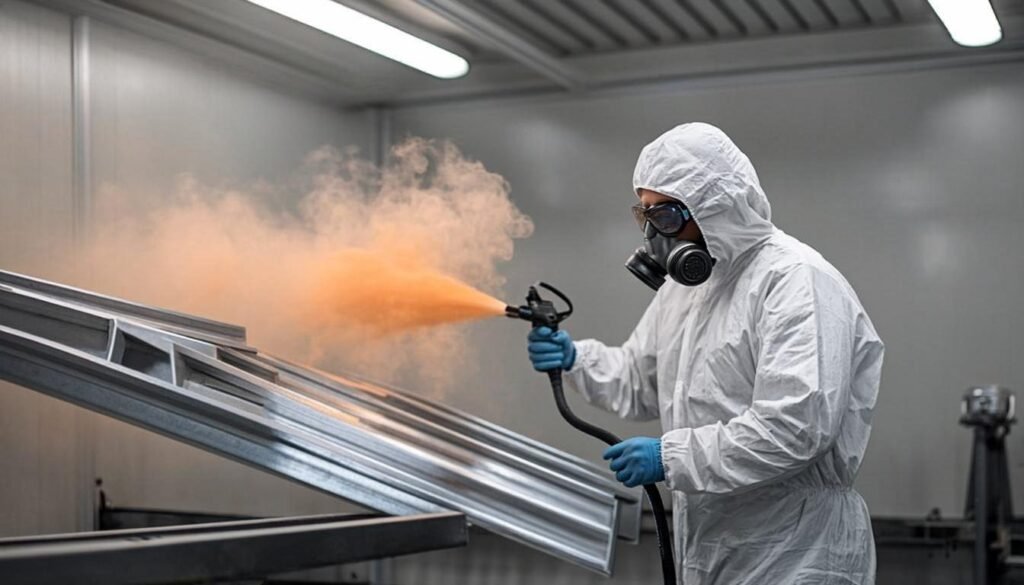
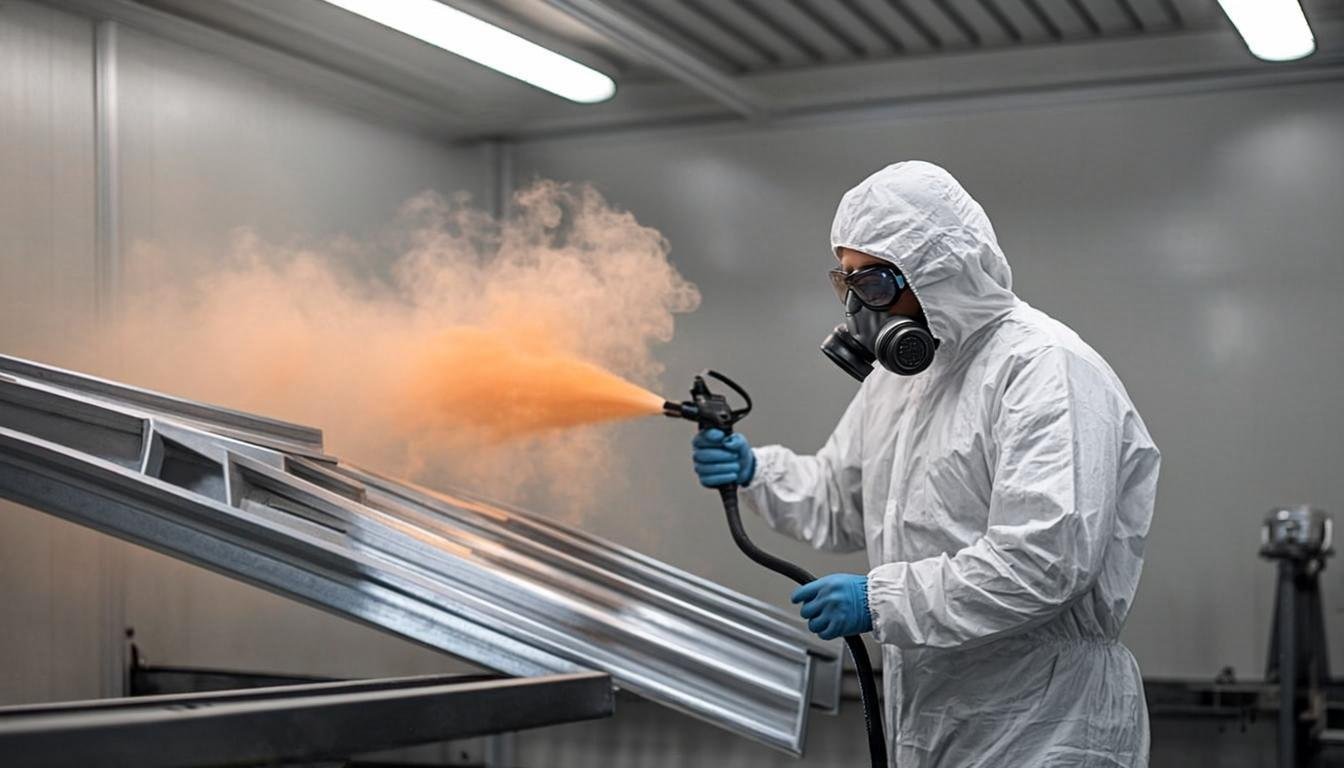
In the electrostatic spray booth, the powder particles pick up a high-voltage charge as they leave the gun, while the part stays grounded. Charged particles are literally attracted to the metal, wrapping around edges and even coating the back side of thin profiles – something liquid paint cannot do. Overspray that misses the part falls as dry powder and can be collected and reused, which is why powder lines reach material utilization above 90%. The same physics has one weakness: deep recesses shield themselves from the charge, the Faraday cage effect, which operators compensate for with gun distance, voltage and technique.
Stage 3: Curing – Where the Thermosetting Chemistry Happens
In the oven the powder goes through two transformations: first it melts and flows into a smooth continuous film, then the resin and hardener chemically cross-link into a single solid molecule – this is what makes it a thermosetting coating that will not re-melt. Typical polyester systems cure at 180-200 degrees Celsius metal temperature for 10-20 minutes. Both variables matter: an under-cured film looks fine but fails impact and solvent tests, an over-baked film yellows and turns brittle. The oven stage is where a coating becomes either a ten-year finish or a warranty claim.
Stage 4: Cooling and Inspection – Prove It Before It Ships
After curing, parts are cooled and inspected: dry film thickness against the specification, cross-cut adhesion, gloss against the approved master, and color measured with a spectrophotometer. Good lines check the first parts of every run, not just the last. This stage is where you confirm the first three stages actually worked – and it is the difference between a supplier who catches a problem and one who ships it to you.
Thermoset vs Thermoplastic: Why It Matters to Buyers
Almost all industrial powder coating today is thermosetting: epoxy, polyester, hybrid, polyurethane and PVDF systems that chemically cure into a permanent film. Thermoplastic powders (like nylon or PVC) simply melt and re-solidify – tough and thick, but they re-melt under heat and bond mechanically rather than chemically. When a supplier says epoxy or polyester, you are buying a cross-linked thermoset engineered for your substrate and environment; that chemistry, not the color, is what you are really specifying.
The Weakest Link Rule
A coating line performs at the level of its weakest stage. Perfect powder over poor pretreatment still peels; a perfect pretreatment with an oven that never reaches metal temperature still fails MEK rubs. When you audit a supplier or troubleshoot a failure, walk the four stages in order – the answer is usually at the first stage where somebody guessed instead of measured.
How Long Does Powder Coating Take to Cure?
A typical polyester powder cures in 10-20 minutes at 180-200 degrees Celsius metal temperature; low-cure systems run at roughly 140-160 degrees. The clock starts when the part – its thickest section – reaches temperature, so heavy racking and dense loads add real minutes before the timer should even start.
Can Powder Coating Be Used Outdoors?
Yes – with the right chemistry. Pure polyester, super-durable polyester, polyurethane and PVDF systems are engineered for UV exposure, while epoxy powders chalk and yellow outside. For outdoor parts, name the resin and ask for QUV weathering data; an indoor epoxy on an exterior part is the most common chemistry mistake buyers make.
Why Does Powder Coating Peel or Flake Off?
Peeling almost always means the film never bonded: contaminated or unconverted metal (stage one) or an under-cured film (stage three). Cross-cut adhesion and solvent rub tests expose the guilty stage within minutes. Fix the stage, not just the part – a recoat over the same root cause will peel again.
See the Process Working for Your Parts
Send us your parts, substrate and service environment. We will recommend the right system – from epoxy and polyester powder coatings through super-durable and PVDF grades – confirm the cure window for your line, and ship sample panels so you can see all four stages working before you commit to a production order.
Need More Information?
Our engineers can help you choose the right powder coating system, color and finish for your project.