
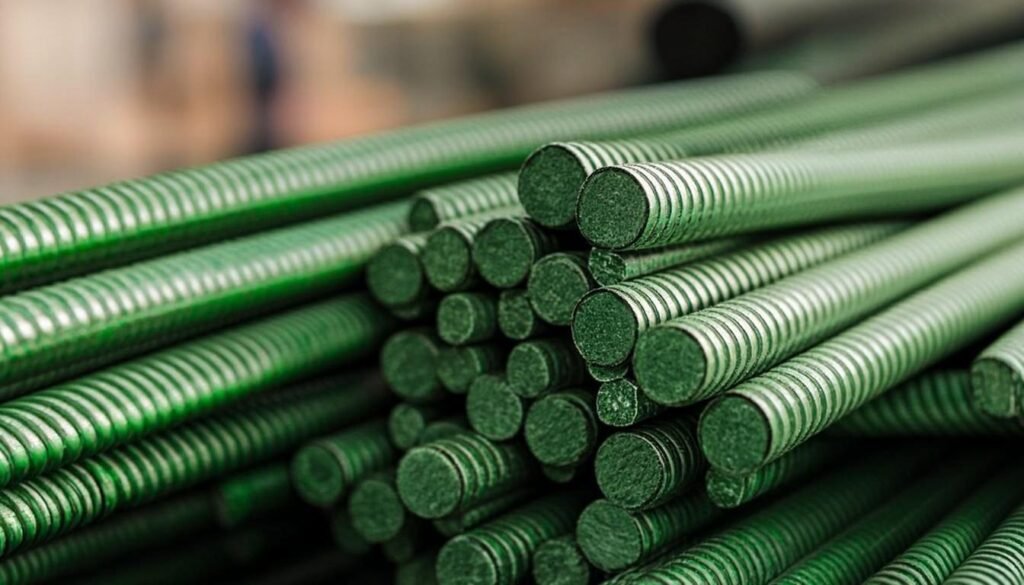
Fusion Bonded Epoxy (FBE) Rebar Coating Explained
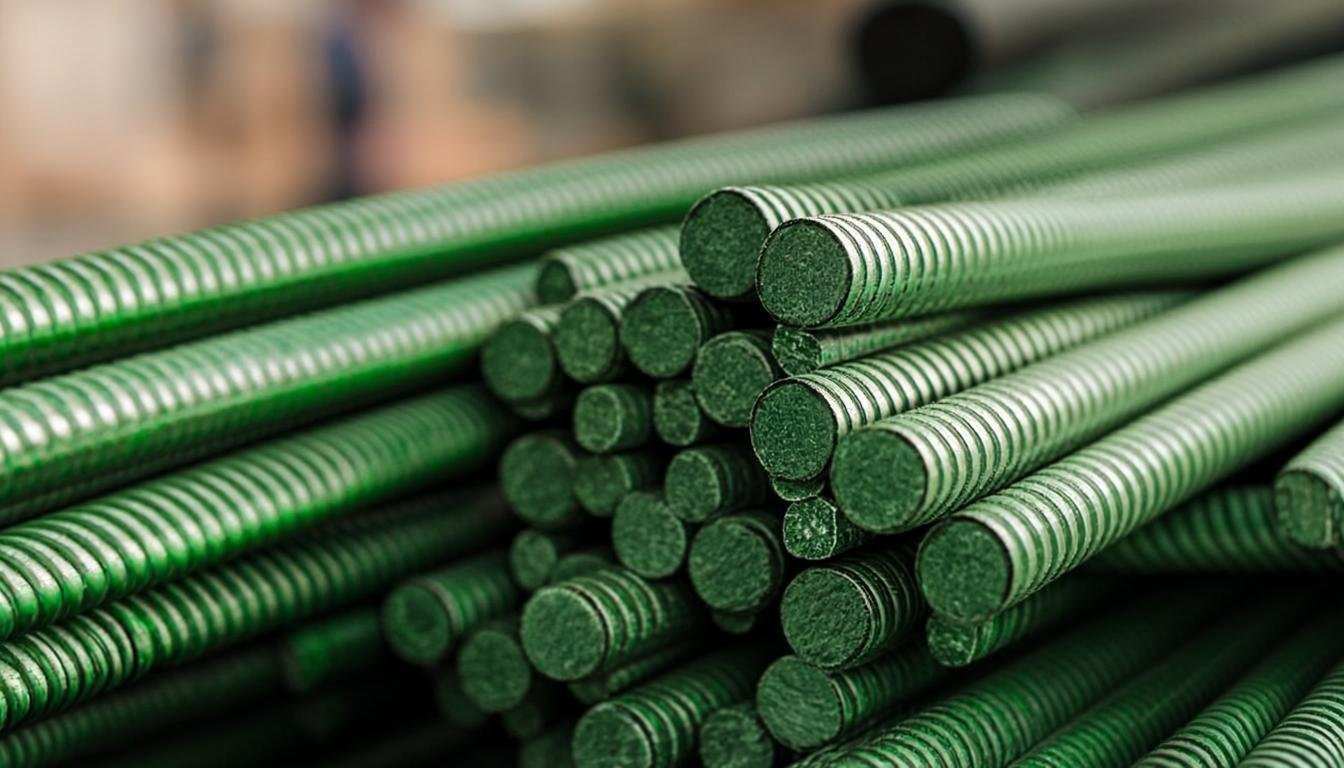
The green-coated rebar you see on highway and marine projects is powder coating by another name: fusion bonded epoxy (FBE). It is a thermosetting epoxy powder applied electrostatically to hot steel, where it fuses and cures into a dense, adherent corrosion barrier. FBE has protected concrete reinforcement and pipelines for decades – and if you buy or apply it, the application details are exactly where quality is decided.
Key Takeaways
- FBE is a one-coat epoxy powder applied to preheated steel, with no primer or solvent.
- Rebar is preheated to roughly 230-245°C so the powder melts on contact and cures from residual heat.
- Typical FBE rebar film under ASTM A775 runs about 175-350 microns.
- Holiday detection and careful site handling decide whether the coating actually protects the steel.
What Is Fusion Bonded Epoxy?
Fusion bonded epoxy (FBE) is a one-coat thermosetting epoxy powder applied electrostatically to preheated steel. On contact it melts, flows and chemically cross-links into a dense, adherent film – no solvent, no primer. That single cured layer insulates rebar and pipeline steel from corrosion, and it has done so for decades.
Why Rebar Needs It: The Chloride Problem
Concrete protects steel because its alkalinity forms a passive layer on the rebar. Chlorides – from de-icing salts, marine spray or groundwater – break that passive layer and corrode the steel from inside the concrete. As rebar corrodes it expands several times in volume, cracking and spalling the concrete around it. FBE breaks the corrosion circuit: an electrically insulating film between steel and the concrete environment, tested by decades of bridge and marine structures.
The FBE Application Process, Step by Step
- Blast cleaning: rebar is abrasive-blasted to a near-white surface for maximum adhesion
- Preheating: bars are heated to roughly 230-245 degrees Celsius – well above the powder’s cure range
- Powder application: FBE powder is sprayed or dropped onto the hot steel, melts on contact and flows over ribs and deformations
- Cure: the residual heat of the bar completes the thermosetting cross-link without a separate oven pass
- Quench: water cooling locks in the cured film and allows immediate handling
Holiday Detection: Finding the Pinholes That Matter
A pinhole or void in an FBE film is a corrosion cell waiting to happen – the steel corrodes under the intact-looking coating. That is why every production run is passed through a holiday detector: a high-voltage electrode that sparks at any pinhole, thin spot or void. Coating plants log holiday counts and repair them with patching material; buyers should treat holiday test records as non-negotiable delivery documents, the same way they treat COAs for other powders.
Film Thickness: The Number That Controls Everything
FBE on rebar typically runs in the 175-350 micron range under ASTM A775. Too thin and holidays and steel contact appear; too thick and the film cracks when bars are bent. Thickness is measured with calibrated gauges on the ribs and between them, on a sampling plan – because on a coating whose entire job is barrier protection, film thickness is the specification.
The Standards Behind FBE Rebar
Most projects reference ASTM A775 (epoxy-coated reinforcing steel: surface prep, thickness, holiday testing, bending) and ASTM A934 (epoxy coating of prefabricated bars before fabrication); pipeline FBE has its own family of standards. Specifying the standard, not just “green coating”, is what makes quotes and deliveries comparable – and gives you objective acceptance criteria at the job site.
Field Handling: Where Good Coating Gets Damaged
Most FBE failures in service start at the job site, not the coating plant: bars dragged across rebar chairs, tie wires cutting the film,UV exposure during long storage, and cuts from handling equipment. The standards require repair of damage with compatible patching compound, and good specs limit outdoor storage time and require padded contact surfaces. If your project keeps coated bars intact from plant to pour, the system delivers its design life.
Bending, Fabrication and Patching
Bars can be coated then bent (within the standard’s temperature and radius rules) or bent then coated (ASTM A934 route for prefabrication). Either way, cut ends and fabrication damage are patched with compatible two-part epoxy mastic – the repair system matters as much as the original coating, so buy patch material from the coating supplier, not the nearest hardware shelf.
What Film Thickness Does FBE Rebar Need?
ASTM A775 governs epoxy-coated reinforcing bar and works with a typical FBE film range of roughly 175-350 microns. Below that range, holidays and bare spots appear; above it, the film can crack during bending. Calibrated gauge measurements on a sampling plan – on the ribs and between them – are the acceptance evidence.
Can FBE-Coated Rebar Be Bent After Coating?
Yes, within the bending temperature and radius limits of the applicable standard, and bars can also be bent first and coated after fabrication. Either route creates cut ends and occasional damage, which are repaired with a compatible two-part epoxy patch – and repairs, like the coating itself, are checked by holiday detection before delivery.
How Long Does FBE-Coated Rebar Last in Concrete?
Decades: FBE has protected bridge decks and marine structures since the 1970s by breaking the chloride corrosion circuit between steel and concrete. Service life depends on film integrity – original holiday rates, handling damage and patch quality – which is why thickness, holiday testing and documented repairs matter more than any single number in a data sheet.
Sourcing FBE Powder You Can Trust
FBE is a specialized thermosetting epoxy powder – formulation, grind and cure behavior decide holidays, flexibility and adhesion. We supply epoxy powder coatings for pipeline and rebar coating lines, with technical data sheets, batch COAs and application support: blast profile, preheat window and film thickness targets tuned to your bar size and line speed. Send us your line details and project specification, and we will start with sample panels and holiday-test results.
Need More Information?
Our engineers can help you choose the right powder coating system, color and finish for your project.